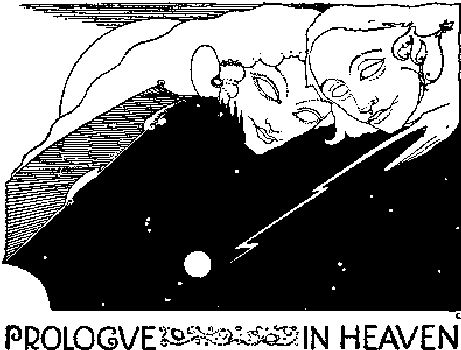
PROLOGUE
IN HEAVEN
from Goethe's FAUST- new English version Mark Scrivener
The
Prologue in Heaven is an essential part of the drama as written by
Goethe. In it the Lord and Mephistopheles ("God" and the
"Devil") strike up a wager over the soul of Faust. To
start the Archangels come forth and recite verses praising God and
creation. Note the reference to the "unheard" and spiritual
harmony of the spheres
that goes back to Pythagoras (see e.g. Shakespeare in the Merchant of
Venice-
There’s
not the smallest orb which thou behold’st
But
in his motion like an angel sings,
Still
choiring to the young-eyed cherubins.
Such
harmony is in immortal souls,
But
whilst this muddy vesture of decay
Doth
grossly close it in, we cannot hear it.).
Mephistopheles
then appears and, as the spirit of negativity, delivers a negative
and sarcastic version of human life on earth. The Lord disagrees and
they argue over the fate of Faust. Note how heaven here appears a
little like a Medieval court (somewhat like a King and Jester). Also
in some respects Goethe sees Faust as an archetypal striving,
post-medieval human being. The Lord maintains in an ambiguous
statement that The
human errs while yet it strives.
And further notes that spirits like Mephistopheles are a spur to
human development overcoming obstacles and
they
prevent humans loving unconditional
rest.
PROLOGUE
IN HEAVEN
The Lord. The Heavenly Hosts. Later Mephistopheles.
Three Archangels come forward.
RAPHAEL
In ways of old
the sun sounds forth,
Where brother spheres as rivals
sing,
Full-ending his pre-written course
With far-resounding
thundering.
His aspect gives the angels might,
Though none may
fathom his foundation.
Works, great beyond thought’s grasp, are
bright
As on the first day of creation.
GABRIEL
And
swiftly, swift beyond all grasping,
There spins the splendour of
earth's light-
A paradise of brightness passing
To dark and
shiver-filled, deep night.
And in broad streams up-foams the
ocean
Upon the rocks' deep-founded base;
And rock and sea
sweep on in motion
In planets' swift eternal race.
MICHAEL
And
tempests roar in rivalry
From sea to land, from land to sea;
In
fury forge wide chains that flare
With deepest working through the
air.
There flashing desolations sear
The path before the
thunder play;
Yet Lord, Your messengers revere
The gentle
changes of Your day.
ALL THREE
This aspect gives the
angels might,
While none may fathom Your foundation.
And all of
Your high works are bright
As on the first day of
creation.
MEPHISTOPHELES
Since You, O Lord, once again
draw near
To ask how things are going down with us,
And since
You used to like to see me, here
Am I where all Your household
helpers fuss.
Please pardon, but I can't work high-worded
styles,
Though all this circle mock and scoff.
I'm sure, my
pathos would just make You laugh,
Had You not sworn off laughing
this long while.
I've nothing grand to spout of sun and worlds,
I
only see that humans plague themselves.
The world's small god is
still the same, old way-
As deeply strange as on the dawn of its
first day.
They'd lead a somewhat better life
If you'd withheld
a seeming sheen of heaven's light.
They call it reason, merely
using this
To be more bestial than any beast.
It seems, please
pardon if it's impolite,
That his is that long-legged
grasshopper's plight,
That tries to fly yet springs along
And
in the grasses sings the same, old song.
Yet would he only lie
within the grasses!
He pokes his nose in any poo he passes.
THE
LORD
You've nothing further but this strain?
Come you but
ever to complain?
Is nothing on the earth now ever right by
you?
MEPHISTOPHELES
No, Lord! I find it there, as ever,
bad right through.
I feel so saddened by the wretched lives of
men
That even I am loath to torment them.
THE LORD
Do
you know Faust?
MEPHISTOPHELES
The doctor?
THE
LORD
My servant.
MEPHISTOPHELES
In truth, his
way of serving's strange enough!
That madcap's drink and food's
not earthly stuff.
His ferment urges him afar.
He's half-aware
of his own craziness.
From heaven he demands the highest stars
And
from the earth all highest happiness.
Yet nothing, from both near
and far,
Can calm deep trouble brewing in his breast.
THE
LORD
If He but serves Me in confusion's night,
Soon I shall
lead him into greater light.
The gardener knows, although the
sapling's green,
In coming years the flower and fruit are
seen.
MEPHISTOPHELES
What will you bet? You'll still
lose him I say
As long as I may have your leave
To lead him
gently down my way.
THE LORD
As long as he's on earth
alive
You're not forbidden to go ahead.
The human errs while
yet it strives.
MEPHISTOPHELES
Thanks there. For never
towards the dead
Have I a bias, so to speak.
For most of all I
love the full, fresh cheek.
If corpses call, I'm not at home that
day.
A cat upon a mouse, that's how I play.
THE LORD
Very
well. Then you may have your day.
So drag his spirit from its
ancient spring
And lead, if you can seize and cling,
Off there
upon your downward way.
Then stand ashamed when finally you say,
A
good man, with a dim, impulsive force,
Is well aware of
rightly-rising course.
MEPHISTOPHELES
Good. Fine. And
little time I'll take,
No fear I'll lose this bet. And for my
sake,
When I attain my aim, my stake,
You'll let my heart fill
with triumphant might.
Dust he'll devour and with delight,
Just
like my cousin, the famous snake.
THE LORD
There too
you may appear as free.
Your type has never had My hate.
Of all
the spirits that deny, for Me
The roguish knave is least of
weight.
The human's doing all too lightly slips to dream
And
soon loves unconditional rest. Therefore
I'm pleased to partner
them with one who's sure
To work and goad, with active
devil-scheme.
But you, true sons of God, delight
In rich
and vibrant beauty's sight.
May-Coming-To-Being, that ever works
and lives,
Encompass you with gracious bounds of love.
And
what's afloat in shimmering sheen-creation
Hold fast with lasting
contemplation.
THE HEAVENS CLOSE, THE ARCHANGELS
SEPARATE
MEPHISTOPHELES (ALONE)
I like to see the Old
One from time to time;
And take pains not to break with Him. From
the level
Of such a Great Lord, it is rather fine
To speak so
humanly with the very devil.